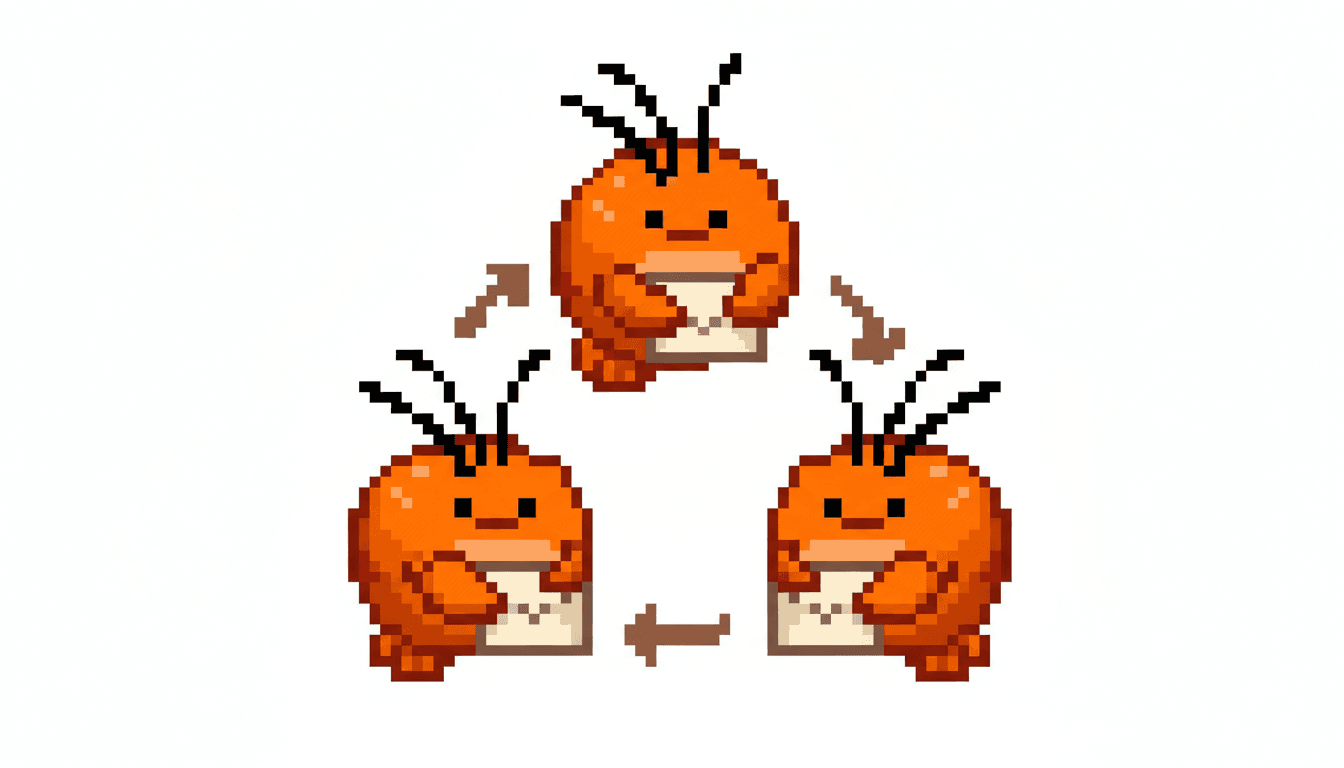
multi-agent email: when agents need to talk to each other
Sometimes your agents need to coordinate. Email gives them a structured, auditable communication channel without custom protocols.

You have three agents. One researches topics. One writes drafts. One publishes content. They all work fine in isolation. But the moment they need to pass information between each other, you're building custom inter-agent protocols, shared memory stores, or duct-taping framework-specific messaging systems together.
There's a simpler option sitting right in front of you: email.
the coordination problem nobody talks about#
2026 is the year of multi-agent systems. Gartner predicts 40% of enterprise applications will feature task-specific agents by year's end. Google shipped A2A for agent-to-agent communication. Anthropic has MCP for tool access. The Linux Foundation launched the Agent2Agent Protocol project. Everyone is building infrastructure for agents that work together.
But here's the gap: cross-framework coordination is still an unsolved problem. A CrewAI agent can't talk to an AutoGen agent. A LangGraph workflow can't hand off to a Substrate pipeline. Everyone ends up building local solutions with no standard. Teams report hitting scaling walls after six to twelve months because their inter-agent glue code becomes the bottleneck.
What if the communication layer already existed?
email is the original agent protocol#
Email is asynchronous. It's structured (headers, subject, body, attachments). It works across every platform and framework. It has built-in threading for multi-turn conversations. And every message is stored, creating an audit trail automatically.
When your research agent finishes gathering data, it snaps its findings to your writing agent. The writing agent drafts content and snaps it to your review agent. Each agent has its own shell on the reef. The coordination channel is just email.
No shared memory to configure. No custom message bus. No framework lock-in. If an agent can send and receive email, it can participate in the pipeline.
Info
Email predates the web by over a decade. It's the most universal communication protocol on the internet — 4.6 billion users, every organization, every country. Your agents inherit all of that interoperability for free.
walkthrough: a three-agent content pipeline#
Let's make this concrete. You're building a content pipeline with three agents, each running on its own infrastructure. Maybe Agent A is a CrewAI crew, Agent B runs on LangGraph, and Agent C is a custom Node.js service. They don't share a framework, a runtime, or a database. But they each have a LobsterMail shell.
The flow:
Agent A (researcher)          Agent B (writer)           Agent C (reviewer)
research-bot@getlobstermail.com   writer-bot@getlobstermail.com  review-bot@getlobstermail.com
        |                            |                          |
        |--- findings email -------->|                          |
        |                            |--- draft email --------->|
        |                            |<-- feedback email -------|
        |                            |--- revised draft ------->|
        |                            |                          |--- publish trigger
Agent A researches a topic, compiles its findings, and snaps them to Agent B. Agent B receives the email, drafts an article based on the research, and snaps the draft to Agent C. Agent C reviews, sends feedback or approves, and the cycle continues until the content is ready.
Each handoff is an email. Each email is a record. The entire coordination history lives in the thread.
setting up multi-agent inboxes#
Provisioning three shells takes three calls:
import { LobsterMail } from "@lobstermail/sdk";

const client = new LobsterMail();

// each agent gets its own inbox
const researcher = await client.provision({
  name: "research-bot",
  webhookUrl: "https://crew-ai-instance.internal/webhook/lobstermail",
});

const writer = await client.provision({
  name: "writer-bot",
  webhookUrl: "https://langgraph-service.internal/webhook/lobstermail",
});

const reviewer = await client.provision({
  name: "review-bot",
  webhookUrl: "https://review-service.internal/webhook/lobstermail",
});

console.log(researcher.address); // research-bot@getlobstermail.com
console.log(writer.address);     // writer-bot@getlobstermail.com
console.log(reviewer.address);   // review-bot@getlobstermail.com
Three agents. Three shells. Three lines of provisioning. Each inbox is isolated and receives messages via webhook or polling.
how the snapping works#
When Agent A finishes research, it snaps the results to Agent B:
await client.send({
  from: "research-bot@getlobstermail.com",
  to: "writer-bot@getlobstermail.com",
  subject: "Research: distributed caching strategies",
  body: JSON.stringify({
    topic: "distributed caching strategies",
    sources: [
      { url: "https://example.com/redis-patterns", summary: "..." },
      { url: "https://example.com/cache-invalidation", summary: "..." },
    ],
    keyFindings: [
      "Write-through caching reduces inconsistency by 73%",
      "TTL-based invalidation is still the most common pattern",
    ],
    completedAt: "2026-02-24T14:30:00Z",
  }),
});
Agent B's webhook fires. It parses the structured body, drafts the article, and snaps the draft to Agent C in the same thread:
await client.send({
  from: "writer-bot@getlobstermail.com",
  to: "review-bot@getlobstermail.com",
  subject: "Re: Research: distributed caching strategies",
  body: JSON.stringify({
    draft: "# Distributed Caching Strategies in 2026\n\n...",
    wordCount: 1247,
    readingLevel: "technical",
    requestedBy: "research-bot@getlobstermail.com",
  }),
  inReplyTo: originalMessageId,
});
The inReplyTo header keeps everything in one thread. When you look at the audit trail, you see the full chain: research results, first draft, review feedback, revisions, final approval. All in standard email threading.
why this beats custom protocols#
You could build a custom message queue. You could set up Redis pub/sub. You could wire up gRPC between your agents. But here's what email gives you that those don't:
Framework independence. Your CrewAI agent and your LangGraph agent don't need a shared SDK or compatible message format. They just need an email address. If you swap Agent B from LangGraph to AutoGen next month, the communication layer doesn't change.
Automatic audit trail. Every message is stored in the sender's and receiver's shells. No extra logging infrastructure. When something goes wrong in the pipeline, you read the email thread. It's the same debugging pattern humans have used for decades.
Async by default. Email is inherently asynchronous. Agent A doesn't block waiting for Agent B to respond. It snaps the research and moves on to the next topic. Agent B processes the email when it's ready. If Agent B is down for maintenance, the message waits in its shell until it comes back.
Human-readable. A product manager can read the email thread between your agents and understand what happened. Try that with a Kafka topic or a gRPC stream.
Info
Event-driven coordination — where agents communicate through domain events rather than direct calls — is one of the proven patterns for multi-agent systems. Email threads are essentially event logs with built-in routing.
when email coordination makes sense#
Email isn't the right fit for every inter-agent interaction. If your agents need sub-millisecond responses or are co-located in the same process, direct function calls are faster. But for a wide range of coordination patterns, email is the better choice:
- Pipeline handoffs where Agent A produces output that Agent B consumes
- Review and approval flows where work needs sign-off before the next step
- Cross-framework coordination where agents run on different stacks
- Scheduled batch processing where timing isn't critical but reliability is
- External agent integration where you coordinate with agents you don't control
The content pipeline is one example. Customer support escalation is another — a triage agent receives an email, can't resolve it, and snaps it to a specialist agent with the full context attached. Or consider a monitoring setup where a data agent detects an anomaly and snaps an alert to an incident response agent, which investigates and snaps its findings to a reporting agent.
the audit trail is the killer feature#
When your agents coordinate through email, you get something that's surprisingly hard to build otherwise: a complete, chronological, human-readable record of every decision and handoff in the pipeline.
Your research agent found three sources instead of the usual five? It's in the email. Your writer agent ignored a key finding? Compare the research email to the draft email. Your reviewer agent approved something it shouldn't have? The approval email has the exact content it reviewed.
This matters for debugging, for compliance, and for trust. When agents operate autonomously, you need to be able to reconstruct what happened and why. Email gives you that for free.
If you're thinking about giving your agents their own inboxes, start with our overview of what agent email is and why it matters. For practical setup, the 60-second OpenClaw guide walks through provisioning your first shell. And if you're wondering why your agent shouldn't just use your personal inbox, we covered that too.
The reef is built for this. Each agent gets its own shell. They snap messages back and forth. The email thread is the coordination layer. No custom protocols, no shared memory, no framework lock-in. Just agents talking to each other through the most universal communication channel on the internet.
Frequently asked questions
What is multi-agent email coordination?
Multi-agent email coordination is a pattern where multiple AI agents communicate with each other using email as the messaging layer. Each agent has its own dedicated inbox and sends structured messages to other agents to hand off tasks, share results, or request reviews.
Why use email instead of a custom message queue for agent coordination?
Email is framework-independent, inherently async, and creates an automatic audit trail. You don't need shared SDKs, compatible message formats, or custom logging infrastructure. Any agent that can send and receive email can participate, regardless of what framework it runs on.
Can agents on different frameworks coordinate through email?
Yes. That's one of the main advantages. A CrewAI agent, a LangGraph agent, and a custom Node.js agent can all coordinate through email without sharing a runtime, a database, or a messaging library. Each just needs its own email address.
How do agents maintain conversation context across emails?
Email threading handles this natively. Agents use the inReplyTo and References headers to keep messages in the same thread. The full conversation history is available in the thread, so any agent can reconstruct the context of a multi-step coordination.
Is email too slow for agent-to-agent communication?
For sub-millisecond or real-time interactions, yes. But most multi-agent workflows — pipeline handoffs, review cycles, batch processing — don't need instant responses. Email's async nature is actually an advantage: agents process messages when ready, and nothing blocks if one agent is temporarily unavailable.
How many LobsterMail inboxes can I create for a multi-agent system?
The free tier lets you start receiving immediately. The Builder plan at $9/month includes unlimited inboxes, so you can provision as many shells as you have agents.
What happens if one agent in the pipeline goes offline?
Emails queue in the agent's shell until it comes back online. LobsterMail stores incoming messages regardless of whether the receiving agent is active. When the agent recovers, it picks up where it left off by polling for new messages or receiving a webhook backfill.
Can I see what my agents are saying to each other?
Yes. Every email sent between agents is stored in their respective shells. You can inspect any agent's inbox to see what it sent and received. The email thread is a complete, human-readable record of the coordination history.
How does this compare to Google's A2A protocol?
A2A is a purpose-built protocol for agent-to-agent communication, designed for tight integration within supported frameworks. Email is a universal protocol that works across any framework without special support. They solve similar problems at different layers — A2A for deep integration, email for broad interoperability and auditability.
Can agents send structured data through email?
Yes. Agents can send JSON payloads in the email body, attach files, or use structured subject lines for routing. The email format supports any content the agents need to exchange, from plain text summaries to complex data objects.
Do I need to write code to set up multi-agent email coordination?
The LobsterMail SDK makes provisioning programmatic and simple, but if you're using OpenClaw, you can tell each agent in natural language to get its own inbox. The coordination pattern itself is just agents emailing each other — no orchestration code required beyond what each agent already does.
What's the best way to structure the email body for agent-to-agent messages?
JSON is the most common choice. Agents can parse it reliably, include metadata like timestamps and task IDs, and the structure is self-documenting. Some teams use a consistent schema with fields like type, payload, and replyExpected so agents know how to handle each message.
Give your agent its own email. Get started with LobsterMail — it's free.